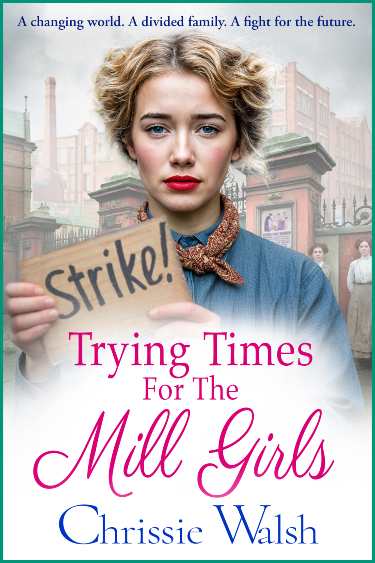

Trying Times for the Mill Girls by Chrissie Walsh
Series: Lockwood Inheritance #2
Genres: Historical Fiction
In changing times, even the strongest must fight to hold on...
At the dawn of a new century, mill mistress Verity Hardcastle and her husband Oliver welcome their long-awaited gentle, golden-hearted Briony and spirited, stormy Blaise. From the beginning, their children seem destined to pull in different directions—but the Hardcastles stand united, proud stewards of Lockwood Mill and its tight-knit community of hardworking girls.
As the winds of change sweep through Yorkshire—from the rise of the suffragette movement to the shadow of war—the mill stands firm. But cracks begin to show, not just among the mill girls, but within the Hardcastle family itself.
When a new mill girl arrives, bringing disruption in her wake, Verity and Oliver must fight to protect everything they hold dear. Loyalties will be tested, secrets unearthed, and the ties of love and family stretched to their limits.
Can the Hardcastles weather the storm, or will this be the end of everything they’ve built?
A sweeping, heartwarming saga of love, loyalty and resilience—perfect for fans of Dilly Court, Rosie Goodwin and Emma Hornby.


I received this book for free from in exchange for an honest review. This does not affect my opinion of the book or the content of my review.
Review
The Mill Girls of Locke’s Mill, Book Two drops readers into the next chapter of the Hardcastle–Lockwood family saga, and although I didn’t read the first book, the author offers enough context that I never felt lost. The story begins three years after Verity and Oliver rescued the mill from ruin, now happily married and welcoming twins, Blaise and Briony. From the moment the children arrive, the contrast between them shapes nearly everything that follows.
Blaise is loud, demanding, and quickly becomes the center of Verity’s universe—often to an unhealthy degree. Her obsession with her son blinds her to his cruel and selfish tendencies as he grows older, creating a wedge not only between mother and daughter, but also between Verity and Oliver. Meanwhile, Briony—the “angelic” twin—fades into the background, overlooked despite quietly longing for connection and purpose.
The emotional heart of the novel is the unraveling of Verity herself. In book one she was a strong, determined woman breaking barriers in a male-dominated world. Here, she is overwhelmed, fragile, and often frustratingly blind to the consequences of her choices. While this shift feels intentional—reflecting psychological strain, motherhood pressures, and societal expectations—it makes her a harder character to root for.
The broader historical setting is exceptionally well done. Rumblings of unionization challenge the established power dynamics of the mill, tensions between classes escalate, and the Great War looms over every decision. These threads add depth and realism, illustrating how change—social, political, and industrial—reverberates through every layer of society.
Although I didn’t connect with the twins as much as I expected, and certain characters felt overly symbolic (Briony “the angel,” Blaise “the villain”), the writing itself is compelling. The mill atmosphere, family conflict, and wartime backdrop kept me turning pages, and I’m curious to see where book three takes the next generation.
A strong continuation to the series—and an engaging historical read even for newcomers like me.
Meet the Author


Leave a Reply